Reviews: FRIJOLE BEANS and HOUSE OF INDIA
by Michael Meigs
One great thrill about the art of theatre is that it is binding but almost never exclusionary. The companies that interest me are small and community based, not the big-budget commercial ventures. Artists and audiences come together for community, reinforcement and messsaging, but almost never are they unwilling to open their doors to anyone.
For the curious and for the outsider—for example, for the theatre writer who prefers to participate in the relative safety and anonymity of the audience—this grants the great privilege of inclusion. For a defined time, that observer sees the world through a different lens, hearing and seeing it through different eyes.
This past weekend at Austin's Emma S. Barrios Mexican-American Cultural Center two contrasting but related communities opened themselves to me, reminding me that the United States is an amalgam of many cultures. Raul Garza's Frijolebeans wrapped me in the warmth and uncertainties of young first-generation Mexican Americans; with the tale of a failing restaurant in a small-town strip mall in Ohio, Deepak Kumar's House of India portrayed a family finding its culture eroding under the pressures of assimilation.
The audiences, both Tejano and Desi, were rapt. These were problems they recogniized, and there were so many similarities between the two works. The head of the immigrant family, either facing old age or recently deceased; middle-aged children at odds with one another over their degree of devotion to tradition; the attraction and allure of opportunities beyond the community; memories of struggle and of affection.
And the food. Communion over traditional dishes is inherent in the titles of these plays: in Garza's piece, the three grown children zealously guard a pot of frijole beans prepared for a community event by mother, unexpectedly deceased; in Kumar's, a central concern is trying to determine how to adapt a menu of dosas, curries, sambar, and chapati to save the family business by attracting a more diverse clientele. Memories of taste and texture, spice and flavor wafted almost perceptibly through the minds of the audiences.
Sets were simple but effective, and in both plays sound design was almost as powerful as those culinary evocations. Vijay Sankaran is credited for House of India (check out the playlist in the program!); the Frijolebeans program doesn't identify the sound designer or the beautifully plaintive ballad used repeatedly for transitions.
FRIJOLEBEANS, directed by Oscar Franco
Three siblings are brought together by family catastrophe. Their mother Gabriella, a matriarch ardently engaged in the struggle to defend Mexican American communities, has died. Playwright Garza defines each of the three offspring with razor sharpness, giving the actors plenty to work with. Erica Saenz as elder sister Lucia is sharp and impatient, a career woman under pressure with grown children, unforgiving with the others. Giselle de la Rosa is Rita, the morose stay-at-home lonely lesbian who has supported their mother for years. Georgy, the youngest, played by David Barrera, is a wanderer, just returned from abroad, full of vague yearnings.
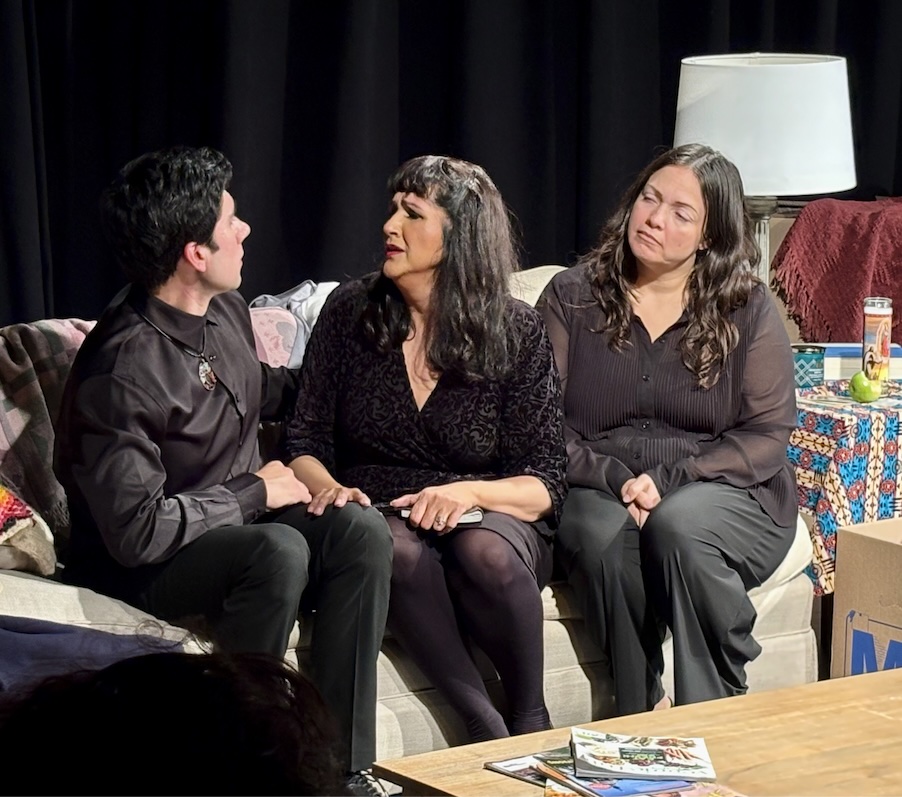
Garza sets them at one another. The structure of the opening scenes reminded me of Beth Henley's Crimes of the Heart and its trio of siblings conflicted between resentments and family affections. The big fridge at stage left becomes a focus as we learn of the significance of the big pot of frijole beans stored there. Then, once these relations and themes are established, the playwright alters the tone by introducing magical realism.
Georgy is alone onstage when from the interior of that big fridge emerges a mystical creature in the form of a mountain lion. Whether memory or apparition, in its dialogue it describes a shared moment in Georgy's youth that may well have shaped his character as itinerant and wanderer. Eva McQuade plays the memory specter that haunts each of the grown children in turn. Not for laughs; she's focused and expressive and different in each turn. Particularly delicious is Garza's scene depicting young Lucia's struggle to learn English by parsing Austen's Little Women.
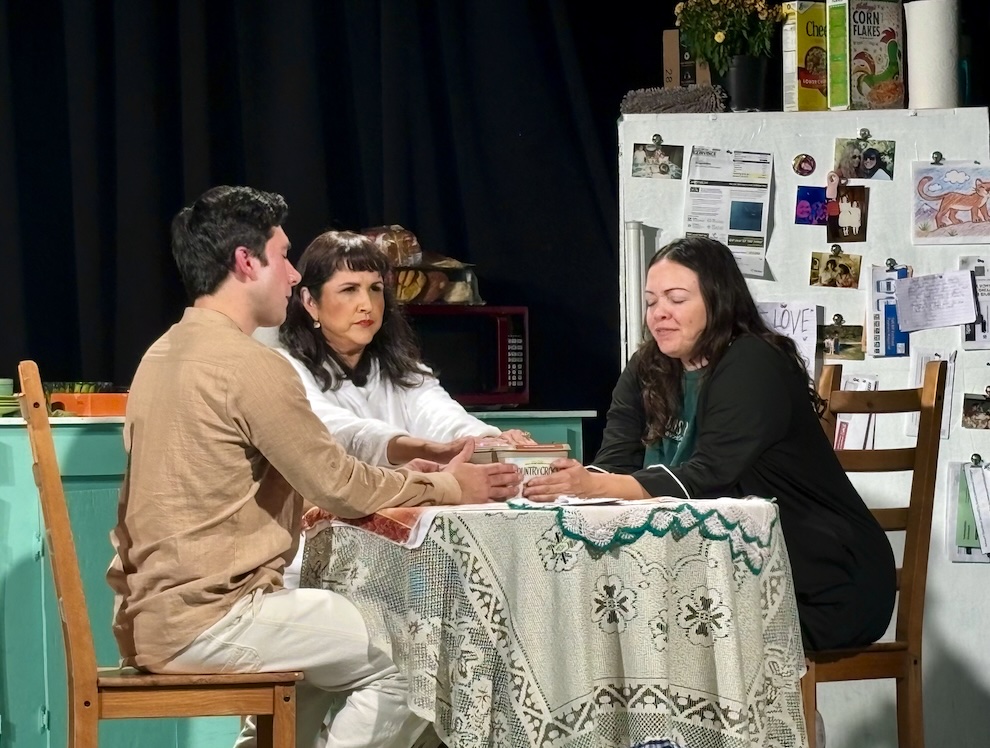 Equally affecting are the siblings' conversations about language. They realize that the Spanish of their childhoods has receded, giving way to dominant American English, sending their experiences into a virtually unreachable past. This is the opposite of my own experience; I clambered awkwardly into Spanish as a teenager, so that my own code switching was never an abandonment.
Inevitably, the final scene is at the table, communing over those frijoles in memory of their mother and re-establishing the bonds among themselves. She's watching them, unseen, from next to that big fridge.
EXTRA
Click to view Teatro Vivo's program for Frijolebeans
 <
HOUSE OF INDIA, directed by Sharanya Rao
"Fusion" is the theme of Deepak Kumar's story of a family restaurant in an Ohio strip mall withering away for lack of clientele. Ananya came to the United States with her husband forty years earlier, when he was full of hope, ambition, and enthusiasm for the cuisine of South India. He is gone now, though a framed portrait over the doorway allows him to beam in blessing over this locale, sacred to his widow. She has scrupulously guarded his recipes. Daughter Vaidehi ("Vi") has remained at home, preserving the legacy as best she can; son Vikram ("Vik") left for New York City immediately after the father's funeral three years earlier, intent on establishing himself as a novelist. Jacob, previously assistant chef, now custodian of the kitchen, isn't of Indian heritage. In the San Diego premiere he was cast as Thai American; in the Austin production his ethnic origins aren't discussed, and the script's examples of fusion cuisine made it a simple matter to cast Marco Antonio Ramirez.

The fusion is more than cuisine, although Jacob's enthusiastic suggestions for blending Mexican and Indian elements rapidly provoke debate. Ananya won't hear of it, at least not at first, for such change would offend against family legacy. The real fusion in the work is that of cultures, and it is incomplete. Vi and Vik have the language, idioms, and attitudes typical of the U.S.-born. They rarely if ever use Indian expressions except when referring to food. As restaurant revenue dwindled over the previous two years, Vi resorted to part time jobs, including in IT, to come up with rent money without telling Ananya, her mom; Vik was practically missing in action, phoning it in, reporting a deal with a publisher, until he turned up at home without explanation, having taken the train from the City. It soon becomes clear that saving the House of India may be impossible.
Note the similarities with Garza's Frijole Beans: a son who sought the wider world but came back defeated; a dutiful daughter who stayed home but also faced disappointment. And the parent—portraying the rigid-lipped Ananya, Kala Malini Ranganathan gives us the lovable stereotype of an Indian ama and auntie, as stern, sharp, and contained as a snapping turtle. Her beautifully rhythmic delivery of her lines contrasts with the grown kids' fluent American, salted at times with profanities when they address one another.
Divya Goruganthu gives Vaidehi a sharp, stressed edge much of the time, especially when she's exasperated with her hapless brother. There's comedy there along with realistic sibling conflict. Vikram confesses failure in the big city—his publisher, if there was one, has terminated the contract for a novel about (what else?) a family-run Indian restaurant. Pranav Shastry gives Vik a lumbering hopefulness, adroitly playing the ccoomedy of Vik trying to replicate their father's recipes.
The restaurant plot line is incomplete, for when the business closes, Jacob comes up with savings and big ideas to re-open under his management, offering trendier blended cuisine. It's not clear whether his innovations will sail or sink the reimagined restaurant. What is clear, however, is that through peristence and charm he has sold Ananya the notion of fusion cuisine. Amid this new hope, we see suggestions that Jacob and Vi are becoming close and that with equal persistence, Vik has made notable progress as a chef.
Ananya accepts the inevitability of change but declines to join it. After forty years in Ohio, she has done her duty. She announces her intention to return to India.
The generations turn, the old order retires or disappears. Assimilation enriches both the upcoming generation and American culture, not seen these days as the "melting pot" cliché of the previous century, but as a new dish as rich and strange as those Jacob is intent on serving to a new clientele.
Leela's House of India played to two full houses in the MACC main auditorium. Artistic director Sharanya Rao cheerfully addressed the home crowd before and after the performance, acknowledging strong support and sponsorship from the community. She offered special recognition to J. Kevin Smith, who had served as liaison to City Theatre Austin for the 2024 staged reading. On the Leela Facebook page, Rao published a five-part video interview with Rathan Rajan Rajendran, proprietor of Sangam Chettinad restaurant at McNeil Crossing, supporter of the production and a source of South Indian cuisine similar to that portrayed in the play.
EXTRA
Click to view Leela's program for House of India

Frijolebeans AND House of India
by Raul Garza, Deepak Kumar
Leela and Teatro Vivo
Two community plays.