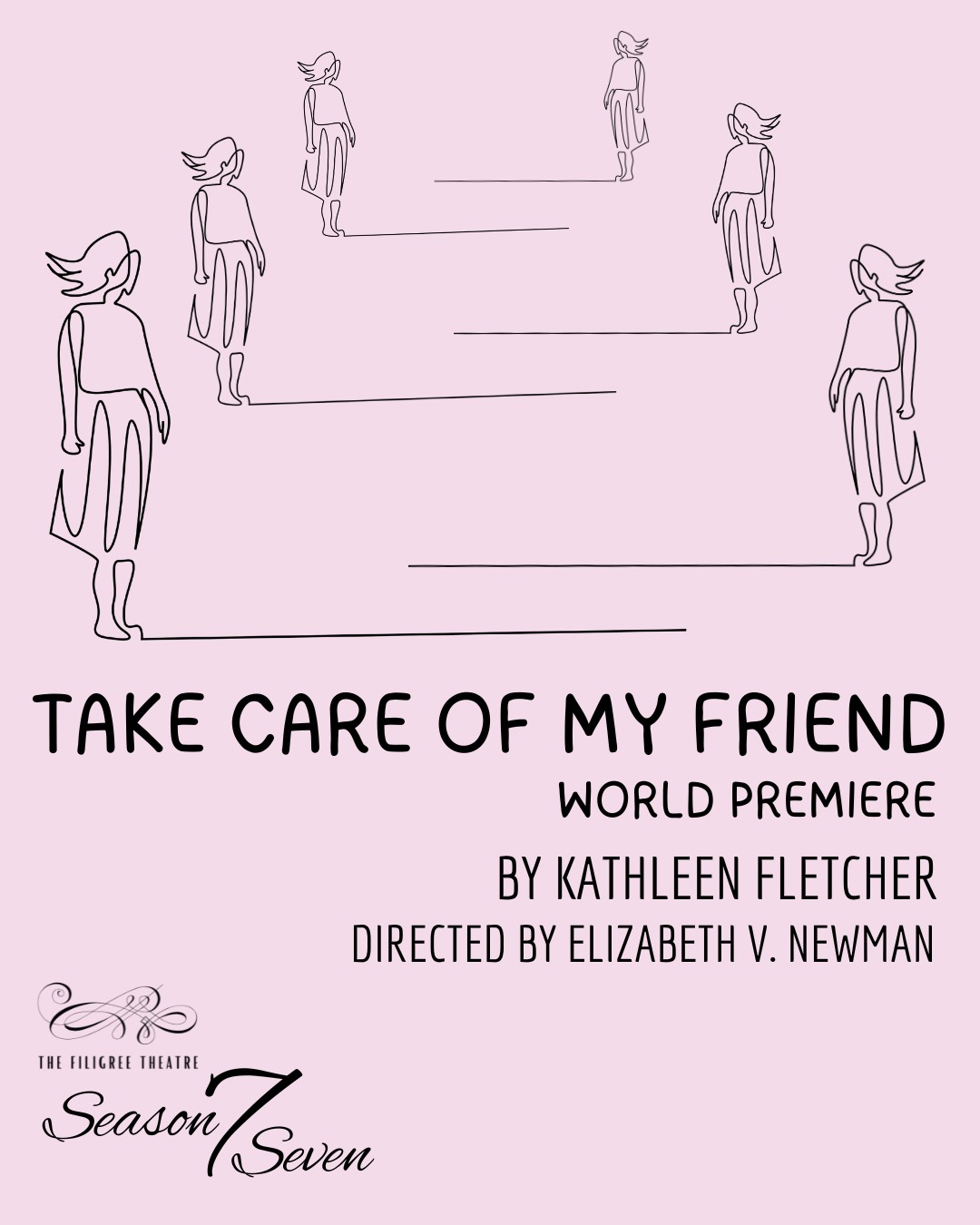
Review: Take Care of My Friend by Filigree Theatre
by David Glen Robinson
Kathleen Fletcher is an immensely powerful actor with great delivery, one who can change characters at the drop of a hat. In her work Take Care of My Friend she has evidently culled the nuggets out of years of personal journals kept during therapy and medical treatments. Regardless of the actual methodology, hers is an auspicious first play that concludes Filigree Theatre’s seventh season.
Playwrights and producers often give audiences a content warning about shows that are “self-therapy on stage” in which actors only portray themselves. Fletcher has the depth, magnitude, and intelligence to sidestep that sort of caution and enlarge her presentation of severe physical, emotional, and mental issues to the larger society. To Everyman. She offers artistic satisfaction to very mature adults, especially to the many who have had debilitating body issues, slept in an ICU not knowing when they might be released or even survive, had long hospital stays for painful treatments, ridden on the therapist merry-go-round, suffered panic attacks induced by the therapist, sat in group therapy with true life losers treating each other, or had an unloving parent leave their life completely. The drawback for the audience was that they weren't cued ("Warning: strong mental and emotional disturbances ahead"), so they could prepare themselves emotionally.
_adj.jpg) To be fair, Fletcher broke the fourth wall at least twice to advise the audience that if they felt overwhelmed by anything, they were free to leave the theatre space and return quietly. Her five co-stars reinforced the message.
To be fair, Fletcher broke the fourth wall at least twice to advise the audience that if they felt overwhelmed by anything, they were free to leave the theatre space and return quietly. Her five co-stars reinforced the message.
Take Care of My Friend is raw autobiography loaded with therapy-speak. That includes the title. In an important sense, the play could be seen as a one-woman show, though there is a supporting cast.
There was no curtain speech. Fletcher stands in front of the stage to start the play and recounts the story of a serious injury by burning during the time she was pursuing a theatre career in New York. She brings the story up to the now in Austin, Texas, with many vignettes and short stories of her life in therapy. As so often with physical trauma, the injury brings forward underlying emotional and mental issues. Fletcher straightforwardly cites her double diagnosis of bipolar disorder and obsessive-compulsive disorder (OCD) sauced with strong suicidal ideations and abandonment issues. And she hurts herself by burning. Still.
One understands that pulling together such painful complexities for a play is itself a literary achievement quite distinct from its production onstage. Sylvia Plath’s The Bell Jar is perhaps the last comparable monument of such topics and themes. I don’t think this is overstatement.
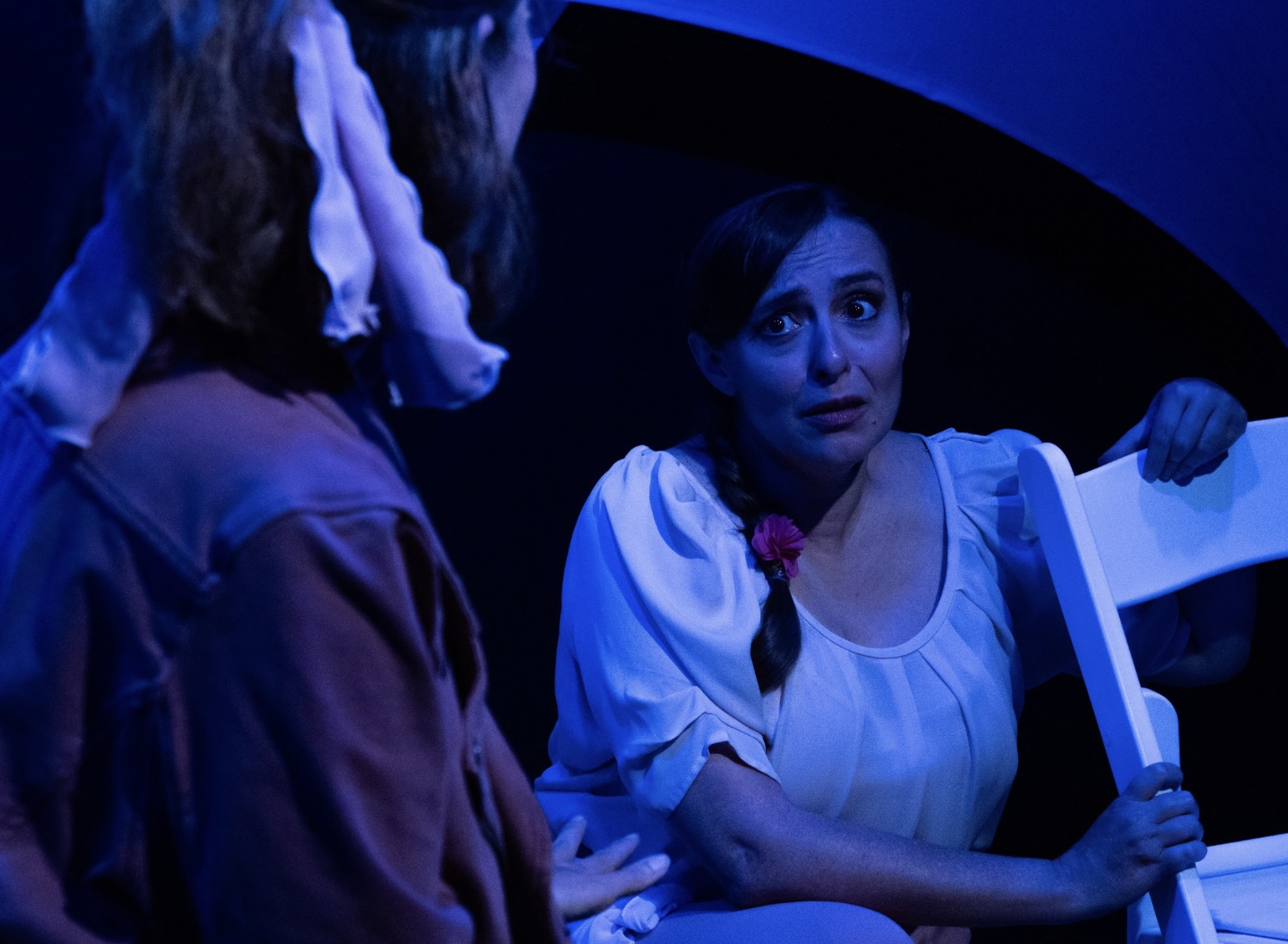
Fletcher’s supporting cast does yeoman work changing characters and voices from one moment to the next. All put in highly competent performances. They are Talya Hammerman, Arielle Laguette, Kerry McGinnis, Molly McKee, and Rachel West. The autobiographical quality of the story gives the play a strong Our Town type of metatheatricality, for they almost constantly reminded us that the audience was co-creating a show on a stage inside a building. This was another way, too, of telling the audience to protect itself from anything unsettling and disturbing, a careful distancing while sharing intimate facts of a life. Director Elizabeth V. Newman wisely guided all involved through the play’s complexities. And Take Care of My Friend was, among its many artistic traits, deeply disturbing.
Despite its revelatory honesty, the script curtains certain areas off from the public. Fletcher reconstructs a few dialogues with her father, but then announces he has removed himself from her life. She has not had contact with him for five years and he will not be a part of her show from that point on. She also has dialogues with a partner but says or recounts nothing about her sex life. Daddy issues, sex, and sexuality underlie almost all emotional (and many mental) issues for which therapy is sought. The silences here obstruct our attempts to comprehend of Fletcher’s journey through profound disturbance. But an audience cannot serve as a collective therapist, and we respect Fletcher’s privacy and clearly delineated boundaries.
_adj.jpg) The design fields beautifully supported the dialogue-heavy show. The set was a simple setting of white folding chairs backed by suspended sail-like white fabric. The lighting sets on the backdrop created a mostly pastel kaleidoscope, reserving intense reds to accent peaks of high drama. Lighting and scenic designer Patrick Anthony proved himself once again to be one of Filigree Theatre’s most valuable assets. Stage Manager Kit Brooks took care of all her stage friends with her usual efficiency.
The design fields beautifully supported the dialogue-heavy show. The set was a simple setting of white folding chairs backed by suspended sail-like white fabric. The lighting sets on the backdrop created a mostly pastel kaleidoscope, reserving intense reds to accent peaks of high drama. Lighting and scenic designer Patrick Anthony proved himself once again to be one of Filigree Theatre’s most valuable assets. Stage Manager Kit Brooks took care of all her stage friends with her usual efficiency.
Take Care of My Friend is not for kids or fragile adults. That hardly needs to be said. The play is a precious (in the good sense), rare record of a young life inscribed boldly and honestly on the face of the world, a petroglyph etched on time. Take Care of My Friend offers a set of images that the thoughtful and heartful can consider like a roadmap to the hinterland of self, saying, "Been here and over there, failed there like Beckett told me. Found love here, failed again harder there. Life is grand.”
Take Care of My Friend runs April 10-25, 2026, at Hyde Park Theatre in central Austin.
Take Care of My Friend
by Kathleen Fletcher
Filigree Theatre
April 10 - April 25, 2026
April 10 - 25, 2026
Thursdays - Saturdays 8 pm; Sundays 3 pm (additional Sunday 8 pm performance 4/19)
Hyde Park Theatre, 511 W. 43rd St at Guadalupe, Austin
BUY TAKE CARE OF MY FRIEND TICKETS HERE