Review #2 of 2: The Last Match by Filigree Theatre
by David Glen Robinson
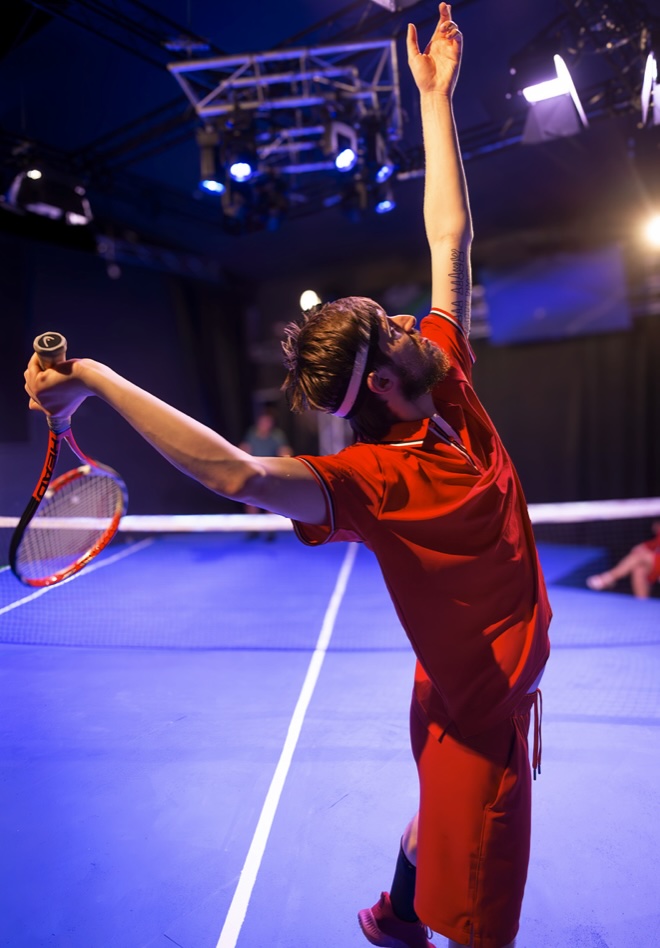 The Last Match is Anna Ziegler’s profound take on sports heroes, the strength and luck it takes to become one and the toll it extracts from the athletes and everyone around them. Director ELizabeth V. Newman's staging is set at a semifinal match of the men’s division of the US Open. Ziegler's script also gives us breakout scenes on the same court—after all, that’s where they live their lives—with interior dialogues and flashback scenes of their self-actualization and existential despair. It seems that both in drama and in real life, we can't have one without the other.
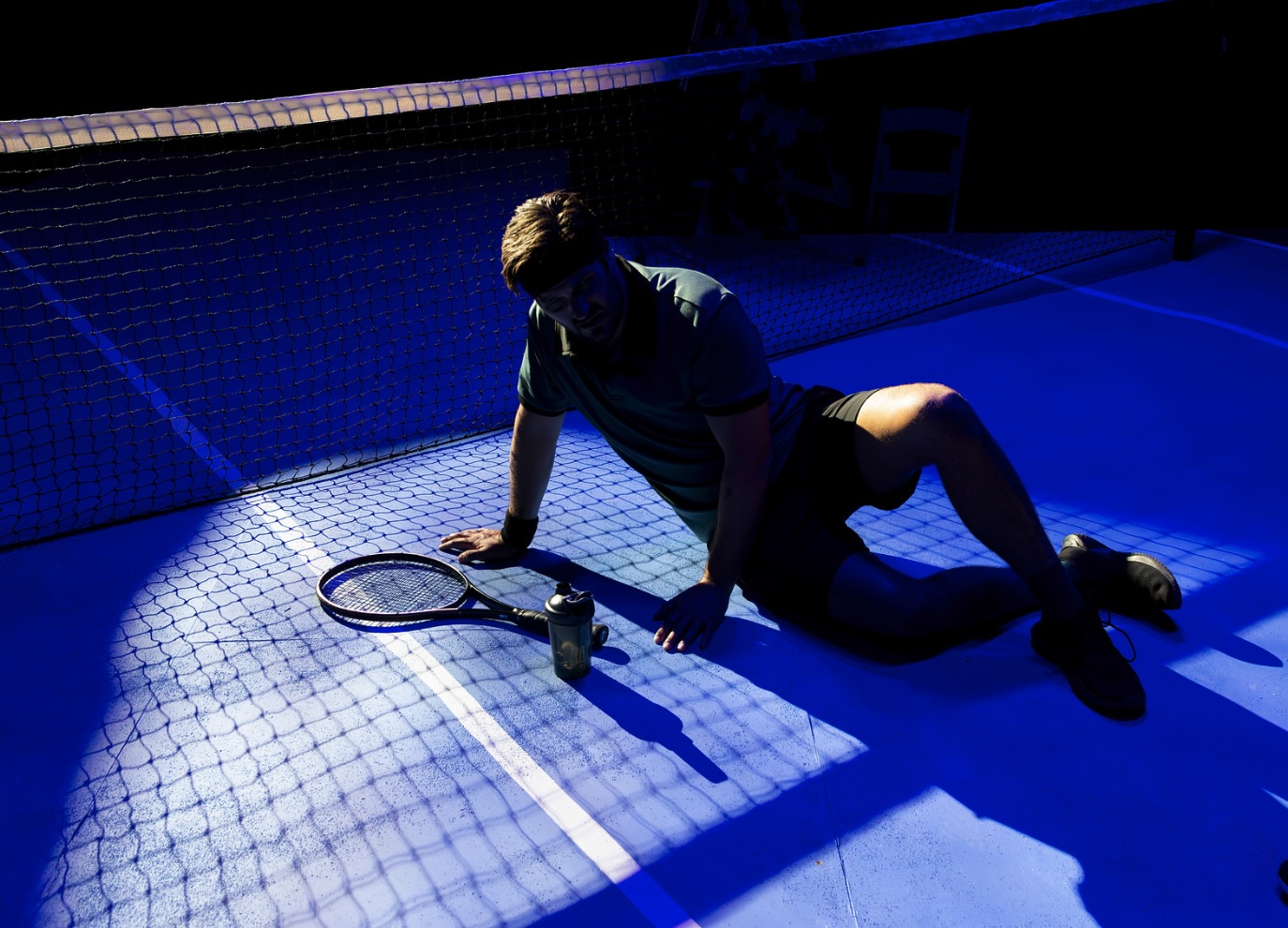
Each contestant is subject to breakdowns where the player stands on the court motionless and seemingly unfocused, aces whizzing past them left and right, like Plato standing in the rain in a philosophical funk, incognizant and uncaring of anything happening. These are hero traits we may have first read in the Iliad; recall Achilles’ refusal to leave his tent while the Greek enterprise was repulsed before the walls of Troy.
But stop. Zeigler cautions us not to drink too deeply of the mead of heroism. She illuminates both the fear of failure and the fear of success. Her play tells three stories. The outward story, crafted in intense action by two-world class tennis players, tells of mythic struggles, like two giants bound face-to-face and pitched overboard into the professional tennis circuit. They call each other "asshole" but lovingly recount the opponent's accomplishments and powers. Here was the love/hate paradox, “fast and slow at the same time” as Tim Porter (played by Ryan Bradley) phrased it when summing up life on the tennis circuit.
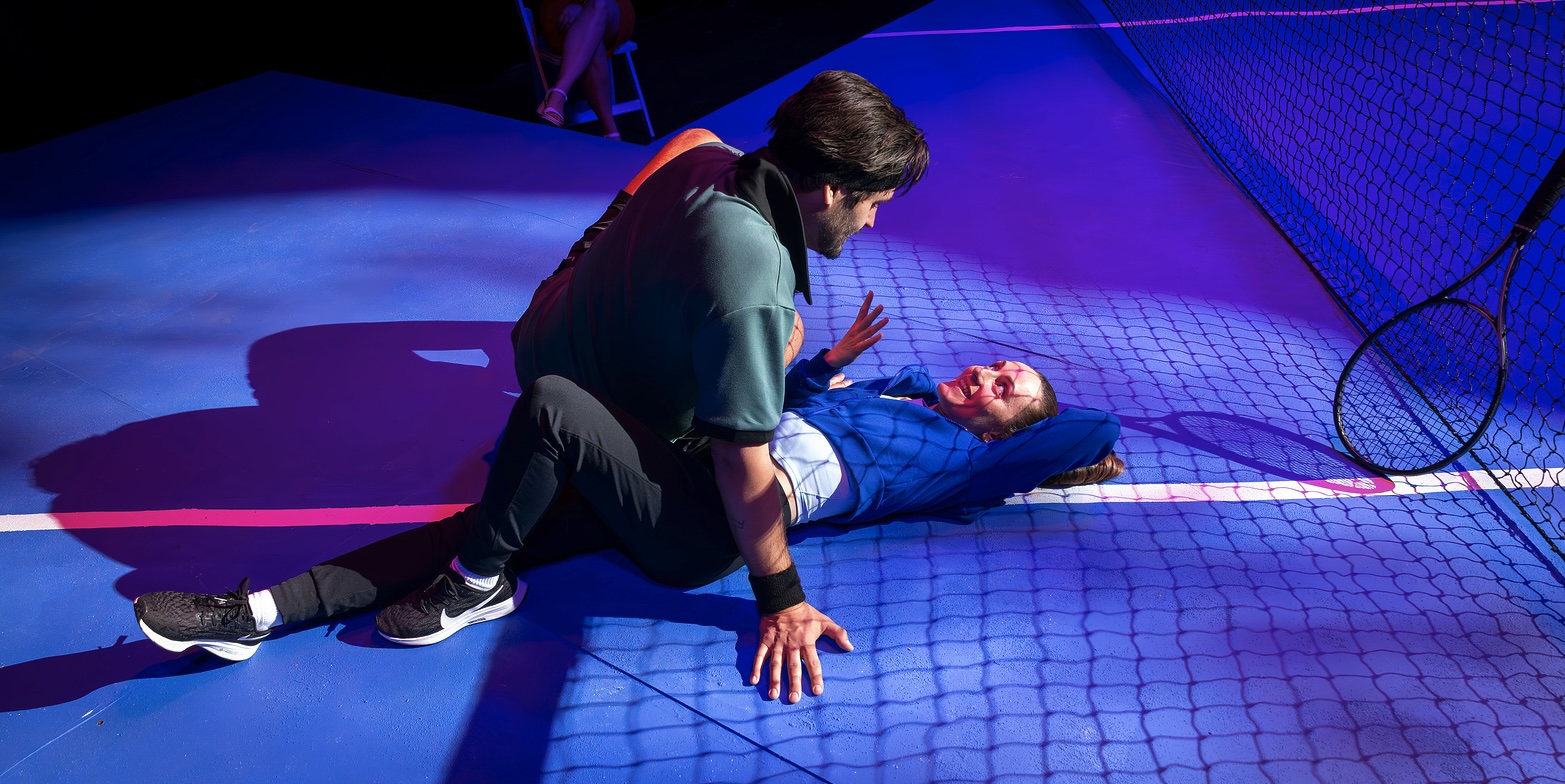
The other stories were the inward stories of players’ relationships: Tim Porter and his wife Mallory (Chiara McCarty) and Sergei (Delan Crawford) and his fiancée Galina (Maddie Scanlan). Porter and Mallory have bitter ongoing disappointments trying to produce offspring, having suffered a miscarriage and a stillbirth. Worse yet, they don’t know, and certainly fear, parenthood and how it will change them. While watched by the audience, they achieve only a partial resolution.
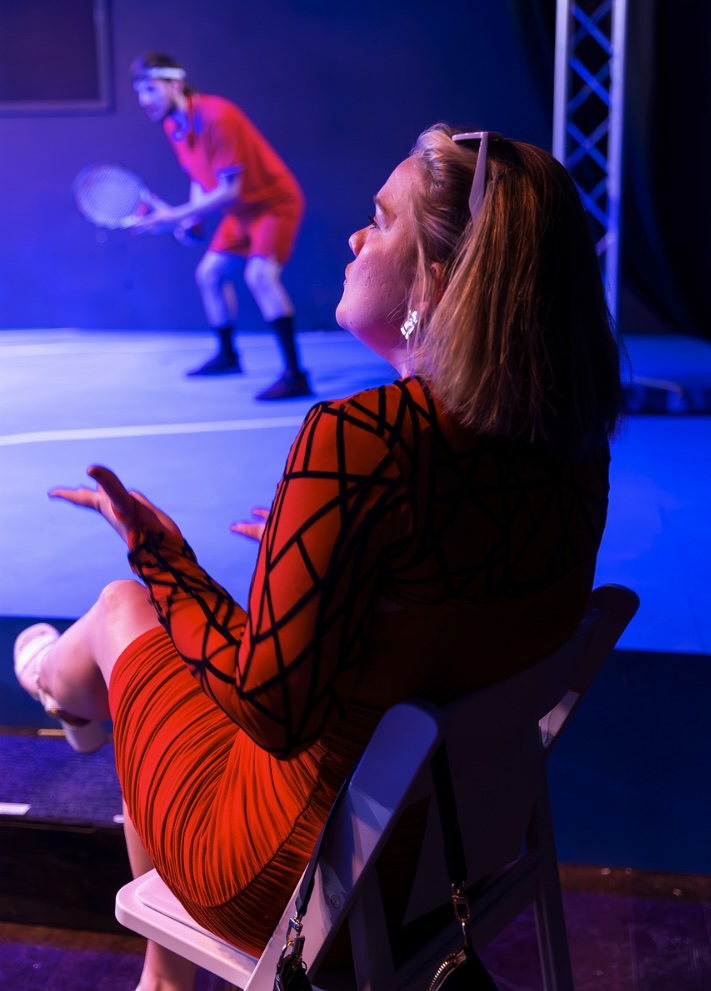 Sergei and Galina want to be together. They seem codependent, but an odd, unexpected asymmetry develops. Sergei has doubts and ambiguous feelings about his talent and success. Galina escaped a lower class upbringing in Russia by migrating to the US “where money fall from trees.” She has no doubt whatsoever that the key to her success is driving Sergei to his. She doesn’t slack off. In one of Sergei’s “Plato in the rain” moments he mentally laments that one of the few things he has is “Galina glaring at me from the sidelines.”
The Sterling Events playing space gave us a scale tennis court wedged in at a diagonal to its everyday dimensions. High screens visually tallied the scoring. The court was an elevated surface, so the audience sat slightly below the action, looking upward at the actors in a rare reversal of the typical audience/stage perspective. House seating was in the vacant, odd-shaped spaces between the tennis court and the event center walls.
The challenge of the tennis net blocking audience sightlines was met by changing the on-court locations of the flashback scenes on the curtainless stage. Clear lighting shifts focused the audience’s attention on flashbacks taking place in the minds and memories of the interlocutors. This technical and artistic success came from the close coordination among the team of the director Elizabeth V. Newman, set and lighting designer Patrick Anthony, sound designer Johann Solo, technical director Beau Harris, stage manager Kit Brooks, and their assistants. Kudos all. Such coordination of the design elements seems increasingly rare in independent Austin theatre. We hope Filigree’s The Last Match will be an inspiring and motivating example.
_adj.jpg) In a phrase: the cast performances are brilliant. Male leads Ryan Bradley and Delan Crawford were required to put in athletic performances portraying champion athletes, and they succeeded. However, one might suggest watching films of John McEnroe’s serves where he tossed the ball high enough to arch his back to fire the ball like releasing a cocked steel spring. Credited movement coach Mike Ooi coached the players on tennis stances and positions.
In a phrase: the cast performances are brilliant. Male leads Ryan Bradley and Delan Crawford were required to put in athletic performances portraying champion athletes, and they succeeded. However, one might suggest watching films of John McEnroe’s serves where he tossed the ball high enough to arch his back to fire the ball like releasing a cocked steel spring. Credited movement coach Mike Ooi coached the players on tennis stances and positions.
Both performers with Russian accents (Scanlan and Crawford) gave clear speeches with good elocution. Kate Glasheen (late of Filigree's Summer and Smoke) was the dialect coach. In a brief discussion with Maddie Scanlan (Galina, and Catherine in last year’s Suddenly Last Summer) after the show, this reviewer learned the playwright wrote, simply, “use Russian accents” for the Russian characters. That work was all on Glasheen and the actors, who not only used good pronunciation but modified grammar and syntax as Russian English speakers would have, dropping articles, etc. Very good work. Kudos there, as well.
Chiara McCarty performed yeoman work as Mallory, the frustrated and tragic wife of Tim Porter. She is fresh from her star turn in Tennessee Williams’ Summer and Smoke, and somewhat farther back, from Albee’s Who’s Afraid of Virginia Woolf? She made a beautiful transformative sequence with a costume piece, going from defeated professional wife to motherhood, still full of questions, but also warm with fulfillment.
The Last Match is highly recommended for tennis fans, students 13 years old and older, and all adults. Anyone who has ever spent serious time thinking about where they are in life will snag a few useful nuggets from this play.
The Last Match runs February 6 to 22, 2026, at Sterling Events Center, near Hwy 290 and Interstate 35, midtown Austin. The play is the mid-season offering of Body and Soul, Filigree’s seventh season.
The Last Match
by Anna Ziegler
Filigree Theatre
February 06 - February 22, 2026
February 6 - 22, 2026
Sterling Stage, Austin