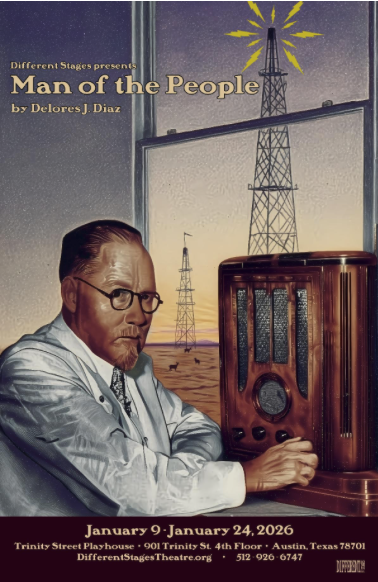
Review: Man of the People by Dolores Diaz, Different Stages, Austin
by David Glen Robinson
Occasionally one witnesses a play onstage so exceptionally good, with superbly written dialogues given by excellent actors fully embodying their characters, that the play transcends the stumbling blocks of production insufficiencies. Such a stage presentation is Man of the People by Dolores Diaz, directed by Mary Alice Carnes and produced by the venerable Different Stages. The actors deliver a multifaceted story that performs open heart surgery on the human condition and walks away leaving it unsutured. You’ll need more than six days in surgical ICU to get over this heartbreaker.
Man of the People, first performed in 2018, is about the charlatan John R. Brinkley who between 1917 and 1939 gained more notoriety than P.T. Barnum. He was known for his elixirs of food-color in water, but even more for his "cure" for impotence—implanted goat testes. Brinkley owned hospitals and put himself out as a doctor (was not) and never, in the era before transplants and rejection drugs, did he research the potential efficacy of his procedures. Thereby hangs a convoluted tale well written by Diaz.

Some of the production problems held the audience back from exploring the insights of the play. Most could be ignored, but some require mention, or there’s no growth. The set looked like it cost twelve dollars and fifty cents and was brought in under budget on the morning of the opening. The upstage wall house left bore a painted stencil pattern intended to evoke wallpaper patterns of the 1920s. The spacings of the stencils varied, and two stencils touched at their edges, completely out of spacing. The bottom row (about hip height—was the painting unfinished?) angled down toward center stage, off-horizontal. The upstage wall house right was finished so poorly that the plywood panels could be seen along their joins. Meant to represent an interior wall of a doctor’s domestic apartment, they looked like a plywood shack. That part of the stage lacked , for example, any framed cozy vernacular paintings to express domesticity and set the apartment apart visually from the office and clinic sets at house center and house left. The lighting design to define the scene locations needed help to make clear changes. Carpets would have helped, but all the audience got was bare concrete floors, out-of-period chairs, and platforms more mid-century than 1920s. The central radio, however, was great.
In our non-proscenium world with no curtain, scene changes must be clear. Scuffed lines and sound/dialogue cues out of synch are forgettable and forgivable, but they do call for a bit more rehearsal.
The audience always needs assistance in getting into the world of the play. The set and lighting design promoted chaos while the audience was trying to absorb the introductory lines in the first-act scenes. Too often, producers and directors give short shrift to the impressions they create in the audience in their pursuit of the grand visions in the dialogue and text. Who cares about a realistic set? We all do. Thank God for a uniformly great cast. They saved a terrific play that deserved better production values.
A Man of the People tells itself around three stories of relationships: John R. Brinkley (the redoubtable Tom Chamberlain) and his wife Minnie (Annie Merritt); Dr. Fishbein (Chuck Winkler) and his mother Fanny (Sue Breland); and Dr. Fishbein and his friend Dr. Maxwell (Beau Paul). All the characters focused on the charlatan Brinkley in some way and responded variously to his world-class chicanery.
Dr. Fishbein’s mother Fanny, who expressed unwavering faith in Brinkley, was the most direct and tragic victim. She called him a doctor, but in his lawsuit hearing, Brinkley was confronted with the fact that his schooling was entirely fictitious. He'd made up the name of a medical academy where he claimed to have studied. Fanny was one of a multitude of believers who was convinced of the con man’s purity and the efficacy of his cures.
 In that, the play made the parallel with religious faith twisted and exploited by charlatans. Deceivers of the ilk of Jimmie Swaggart, exposed when photographed leaving motel rooms with prostitutes. Like Brinkley, Swaggart came back from his scandals to even greater wealth, prestige, and success.
Unlike Swaggart’s adherents, those with unwavering faith in Brinkley risked death. Many succumbed. Fanny’s slow self-destruction drove her son to collapse. He cleverly provoked Brinkley into instituting a lawsuit in which Fishbein could at least confront the charlatan with facts.
Dr. Fishbein and his friend Dr. Maxwell, two retired physicians, were well-bonded friends, who toasted with whiskey “to the men in the room.” Beau Paul’s dialogues were largely explanatory text, delivered superbly as always—excellent chemistry between him and Winkler. Paul's character almost never failed to lift Fishbein out of depression and offer him alternatives to his hatred of Brinkley. He stoutly counseled against denouncing Brinkley in print and thereby inviting a lawsuit. But Fishbein knew what he was about: trapping Brinkley on his aggressiveness. The lawsuit, thoroughly depicted, crushed Fishbein.

In this there is another modern-day comparison, and this one is with Jeffrey Epstein. Epstein always pushed back no matter how thoroughly his filth, crimes, and corruption were exposed. He hired the best lawyers in America, both Democrat and Republican, to dodge accountability and justice for ruining the lives of uncounted women. So with Brinkley, who didn’t restrict himself to the medical exploitation of girls.
 The relationship between Brinkley and his wife Minnie Brinkley started sweetly enough. She was a sunny, uneducated Kansas girl, although Annie Merritt’s accent is closer to Mississippi than to Kansas or Texas. Married to a doctor, always a good choice (she didn’t know his fakery at that level), she just wanted to have a baby. And because the play belongs to the more explicit 21st century, not the 20th, Chamberlain and Merritt enacted a conception event, largely clothed and behind a doctor’s office screen. It’s a trend. At least there was no onstage vomiting.
The play follows the offspring through pregnancy and infancy. Meanwhile, through deceptions and accusations, lawsuits and relocations, Minnie gradually awakens to Brinkley’s monstrousness. She puts much stress on the relationship, which Brinkley counters with all the tools of his sociopathic lying, until she forces him to come clean in the last scene of the play.

The penultimate scene would have made a better ending, although it is all Götterdammerung, which modern playwrights and audiences are chary to touch. Close to the borderline of life and death, sometimes things become clear. Winkler has the lines, Beau Paul attending. After several beatdowns by Brinkley and the fate of his mother, Fishbein gives up on humanity. Maxwell gives only muted objections as Fishbein explains with examples how humanity is helpless and cannot protect itself from evil. Awareness of the problem by the enlightened and powerful just makes it more painful. Ecce Homo? Fishbein says it is to dust.
Find joy in the performances of the cast. They are, without exception, worthy of your adulation.
Children under 12 should stay at home for their parents’ comfort. Otherwise, Man of the People is recommended to all except interior designers. It runs through January 24th, 2026, at Trinity Street Playhouse, downtown Austin.
Man of the People
by Dolores Diaz
Different Stages
January 09 - January 24, 2026
Black Box Theatre, 4th floor, First Baptist Church
901 Trinity Street
Austin, TX, 78701
January 9-24, 2026
Trinity Street Playhouse
901 Trinity St. First Baptist Church, 4th Fl
Austin, Tx 78701
Thursday-Friday- Saturday- at 7:30 p.m.,
Sunday at 2:00 p.m.
$17, 27, $37 pick your price
For information call 512-926-6747
For tickets https://www.differentstagestheatre.org