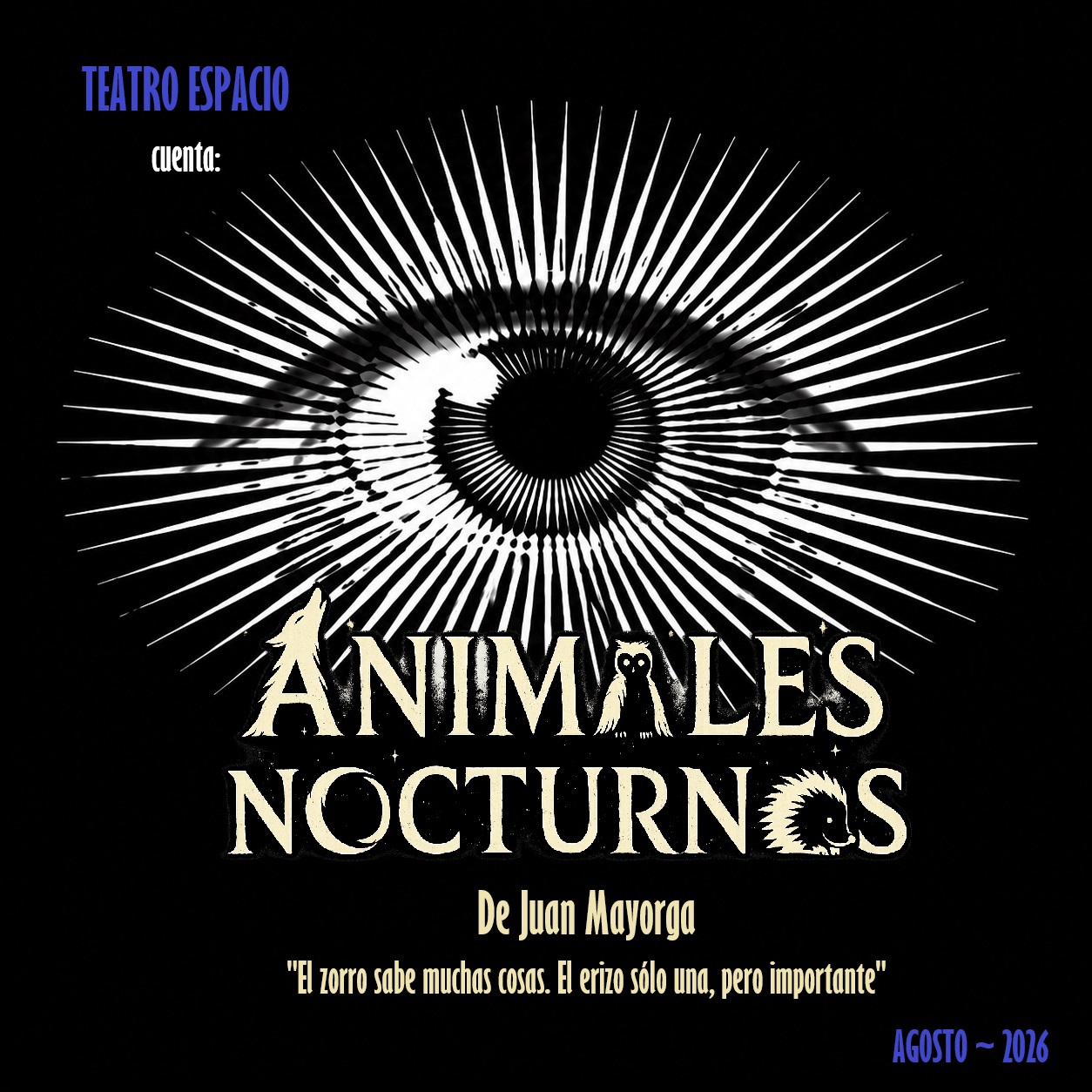
Review: Animales Nocturnos by Teatro Espacio, Austin
by Michael Meigs
Performed in Spanish,
with English-language translations
projected at stage rear
Shadows dominate. An almost nonexistent structure of thin steel rods encloses vacant cubes deep in the stage, suggesting two living spaces side by side. Minimal furnishings, mostly of metal. Like cages. At night.
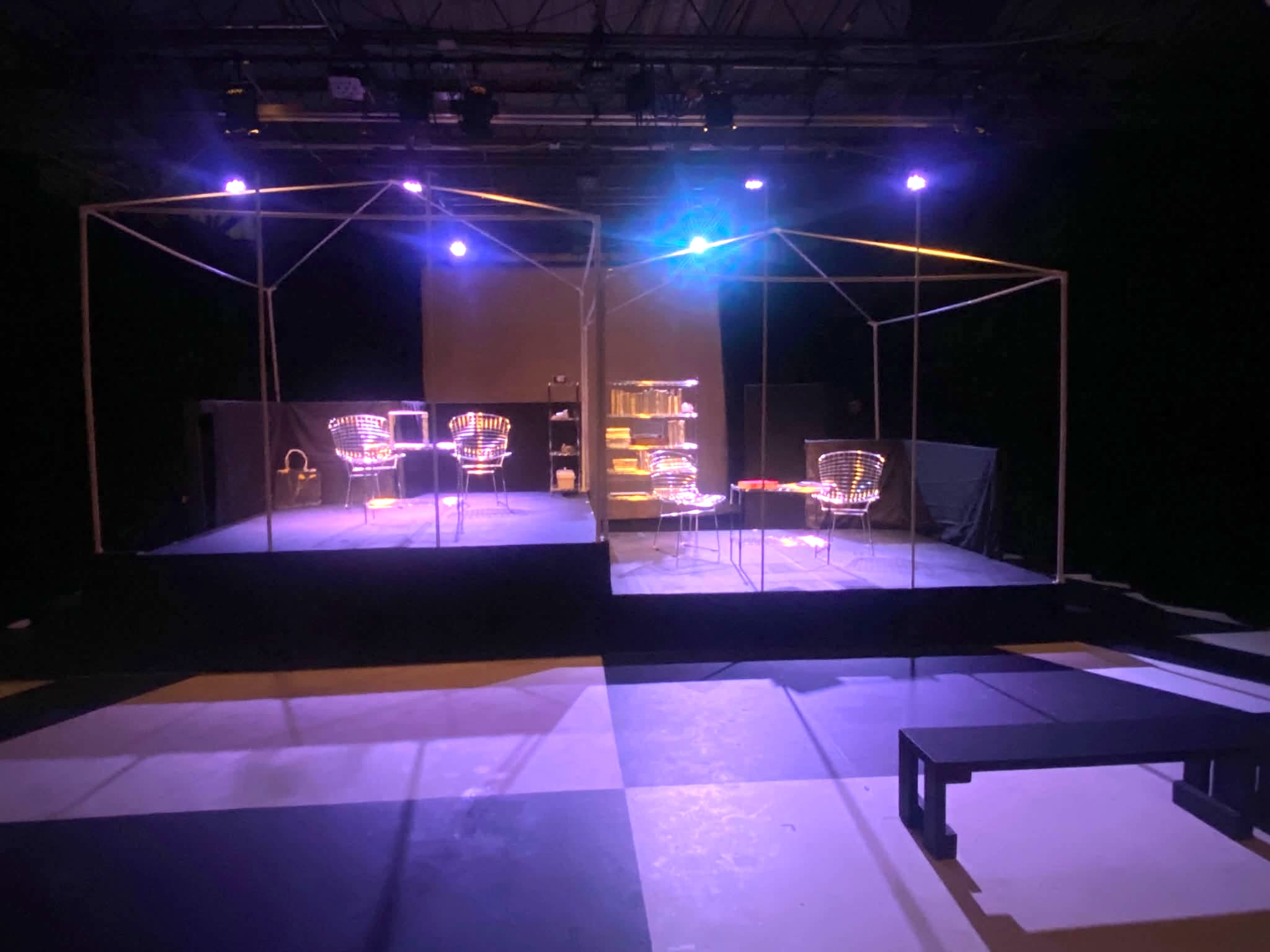
Director Ana Laura De Santiago’s design achieves the same effect for Spanish playwright Juan Mayorga’s Animales Nocturnos as do the photos, posts, and program images by Andrea De Santiago and Néstor Daniel Almanza: menace and uncertainty.
Four actors are two couples in this otherwise undefined space. Their characters are just as undefined at first. The country is not named—presumably Spain at the 2003 premiere but just as credibly the United States today. Perhaps to point to this country, Teatro Espacio’s program labels them the “tall ones” and the “small ones.” A curious choice. In Spanish the implications seem more loaded. El hombre bajo; el hombre alto; la mujer baja; la mujer alta. “Bajo” could also suggest lowly, crude, or mean; “alto” could be rendered as haughty, implying upper-class. Maybe a better match: the big man; the little man.
In the early morning encounter of the two men, Salud Ortiz, el hombre bajo, is indeed noticeably shorter than his neighbor. He’s stocky, bearded, voluble, and vaguely menacing. Daniel Almanza reacts with uncertainty, perhaps confusion, when el hombre bajo insists they’ve seen each other every day.
To an anglophone ear this sounds almost like a Harold Pinter intro, especially when one man comments with smug certainty that he knows the other is undocumented and living illegally in the country. That power play in the tone of casual conversation has an unmistakable implication: Be polite, respond to me, play nice. You know. I can turn you in.
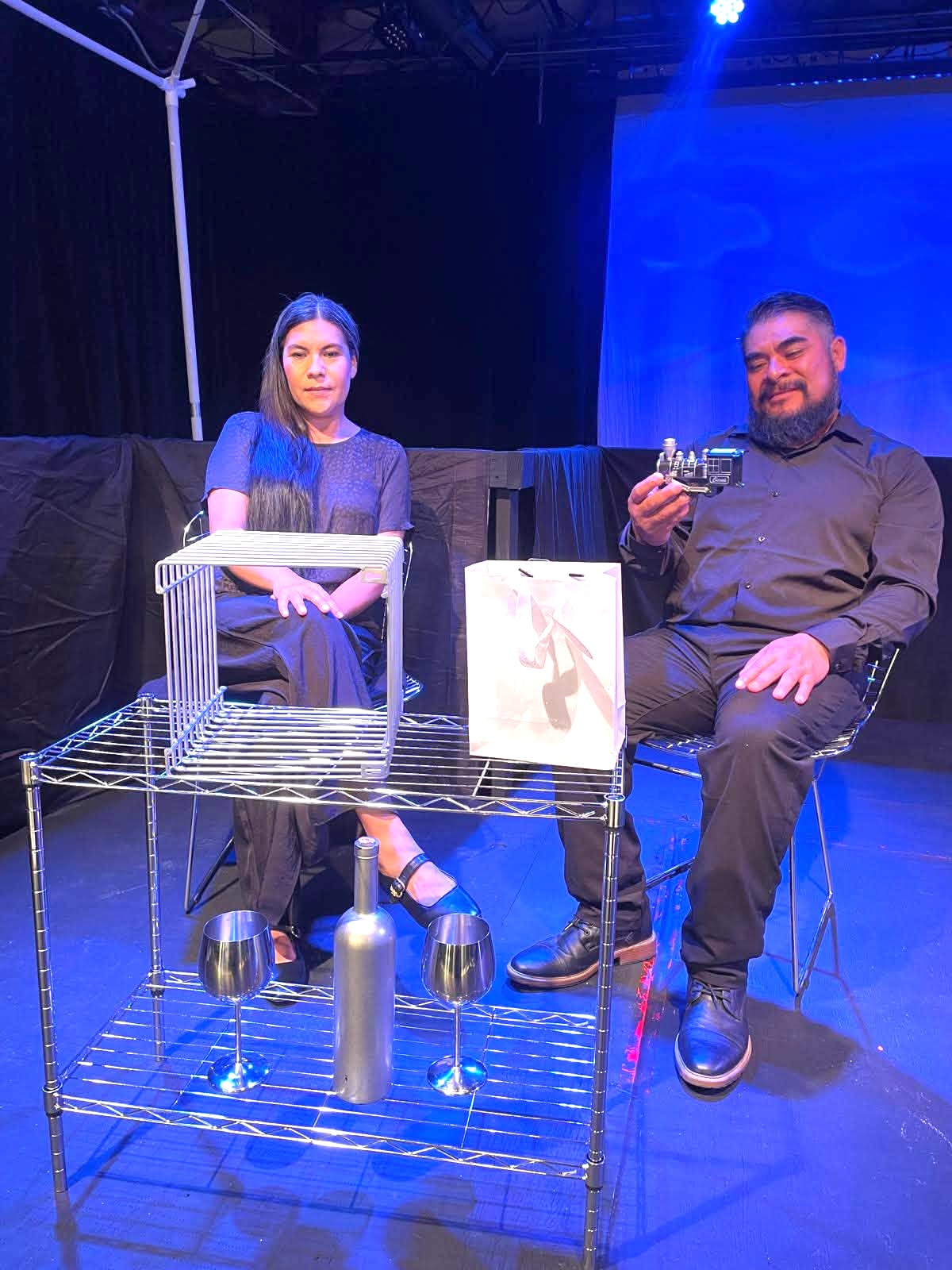 Their mates endure dismal existences. Lorena Elias is la mujer baja, an unhappy insomniac addicted to a late night program for the sleepless. Appropriately, the television is represented by an empty steel cage. Samia Said, the mujer alta next door but eons away, works with words, a free lance translator; that’s one of the most uncertain employments imaginable. These women do not meet during the play. They speak only to their men.
As the men subsequently come together repeatedly for conversation, we find that despite their mannerisms, the reticent, intellectual, quietly patrician hombre alto is in fact the one living in the shadows, working the night shift at a care home and avoiding the law. Salud Ortiz, for all his brass, is the citizen. He has a day job of some sort. That’s about all we know, other than the fact he’s handy; he likes to fix and mend. And talk about it.
One evening, outside in the dark, el hombre bajo dominates the interaction as usual, this time pointing out and identifying wild animals lurking in the dark. El hombre alto listens, acquiescent. This is the pattern: one glib, the other silent. Given the threat implied earlier, the relationship that develops could be seen as exploitation, approaching that of a callous master and a submissive servant.
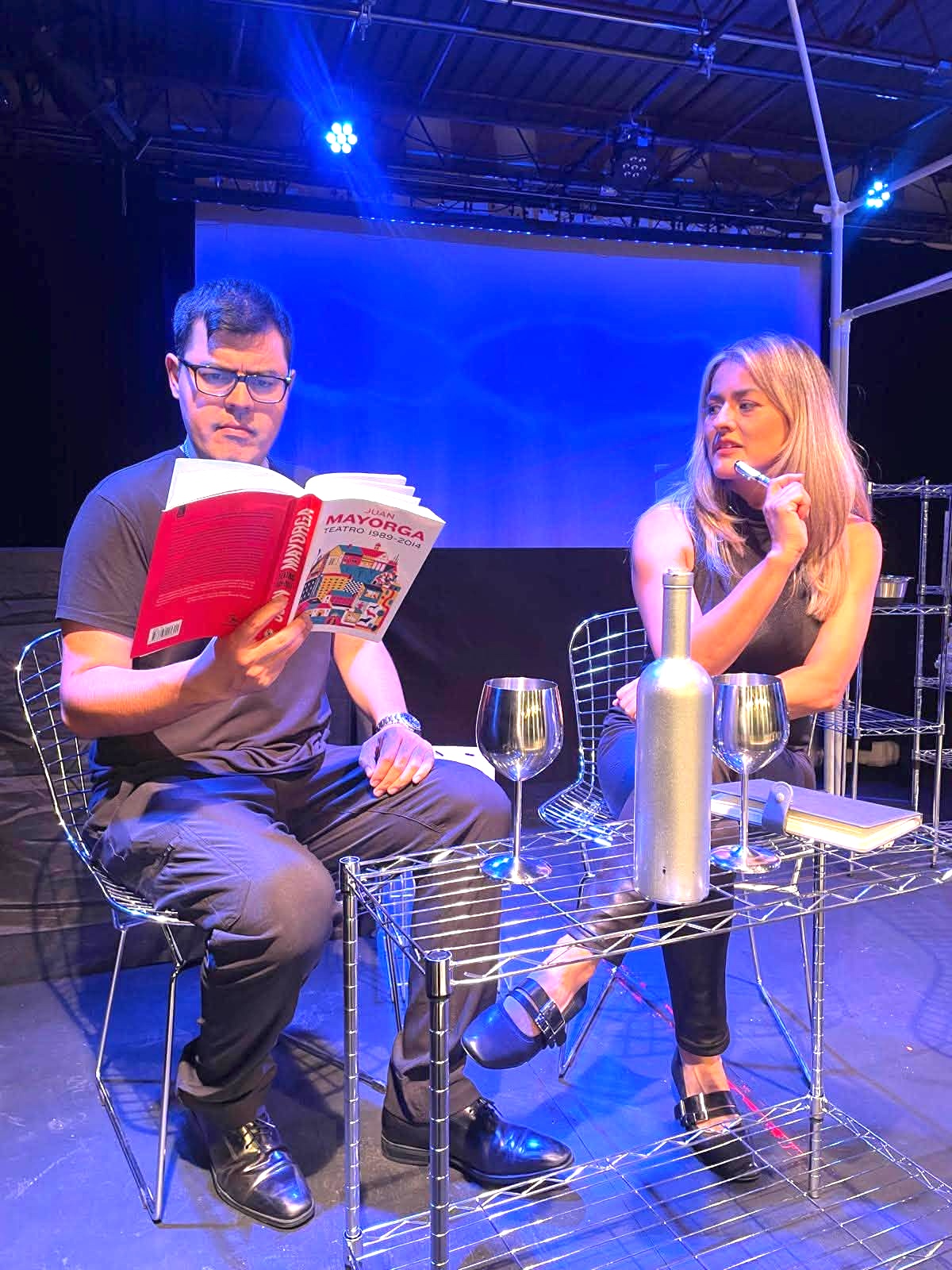 But not so fast. Daniel, as the big/tall man, finds it difficult to describe this to his wife. Yes, he’s been forced to accept wine to mark the birthday of the hombre bajo, who seems particularly embittered by something (not Daniel). She’s bothered by the story and bothered even more when she’s home alone and el hombre bajo comes knocking. He offers to fix the apartment’s erratic lighting. She reluctantly lets him in. He traces the circuits, makes a neighborly remark or two, probably identifies the problem, leaves. She’s creeped out.
Now, correct me if I'm wrong: the characters aren’t named in the program, but I don’t recall hearing any of them addressed by name either. Perhaps they were; but for me, each of them existed in a state of namelessness that underlined their anomie. Though married, each of the four characters is restless and unfulfilled. The relation between the two men evolves into a curious friendship and co-dependency.
Responding to this, the wives take divergent action. One walks out; the other walks in, abandoning moody self absorption. That emotional crossroads is marked by an unforeshadowed two-on-one tango that erupts onstage. The actions and their consequences are further abstracted in the ending moments when another couple, uncredited, slide in from the shadows to move swiftly and smoothly through a dramatic professional tango sequence.
The script, acting, and direction of Animales Nocturnos are carefully prepared and precisely executed. Juan Mayorga’s piece is as suspenseful and melancholy as the classic Argentine dance of passion.
Juan Mayorga (b. 1965) has been writing for the theatre for well over thirty years. He's greatly admired and has been awarded many honors and prizes. Though his works have been translated into twenty-five languages, if you’re a native English speaker, you have probably never heard of him. I hadn’t. And now I’m glad that Teatro Espacio has brought him within my reach. In its program the company gratefully acknowledges Mayorga’s “extraordinary support and confidence in this production.”
The projected titles of English translation will be helpful to anglophones, though they are partly obscured by the cage set and in some sequences the background flares with yellow or orange that obscures the texts.
EXTRA
Click to view the Teatre Espacio program for Animales Nocturnos
Animales Nocturnos
by Juan Mayorga
Teatro Espacio
August 13 - August 23, 2026