Review: Waiting/REX by Ishida Dance Company
by David Glen Robinson
The concept of Ishida Dance Company's contemporary dance performance waiting/REX amazes at first blush, being a companion presentation of Beckett’s Waiting for Godot and Sophocles’ Oedipus Tyrannus. The two together seem an odder couple than Estragon and Vladimir in Godot. Odder still, the abstraction and rendering of the plays in contemporary movement (no lyrics, no spoken lines) are surprisingly faithful to the narrative progress of both. Ishida makes the claim that waiting is the first dance rendering of Waiting for Godot. The design fields coordinated well to limn the complexities of the stories and make them clear. waiting/REX is simply brilliant.
In her curtain speech, Brett Ishida gave a lit crit precis of Waiting for Godot in terms of author Samuel Beckett’s life experience. He and his wife lived in Paris and participated in the Resistance in World War II. They and their colleagues, not all of whom could be trusted, lived furtively and in constant fear of capture and dire consequences, including death. In this sense, the name Godot can be viewed as a shortened, coded form of Gestapo. The fact that Godot never arrives, so perplexing to many theatre aficionados, may be proposingthe highly unusual theme of liberation by negation, winning by not acting.
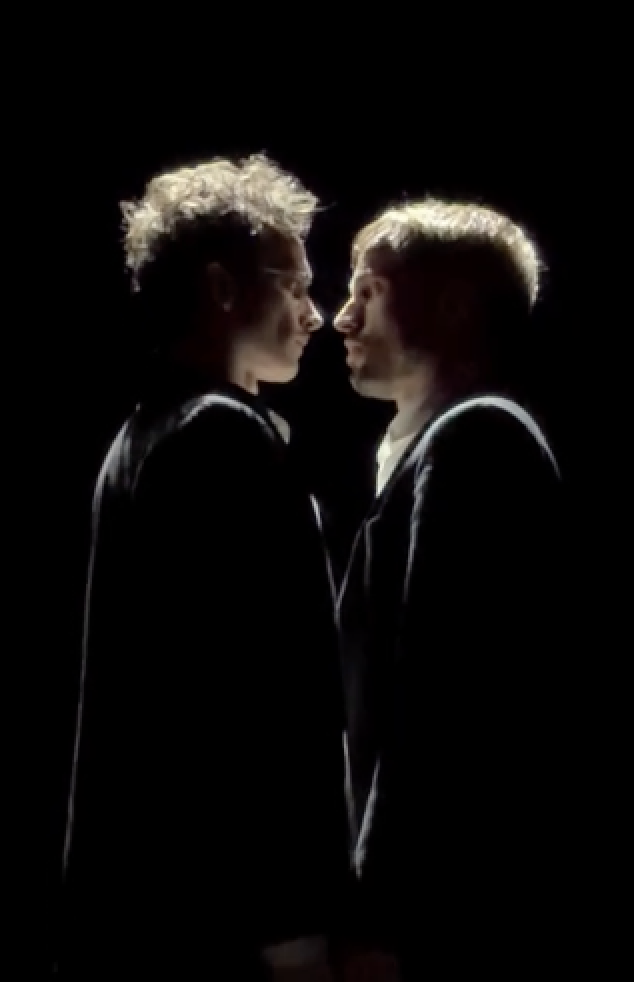 Ishida keeps her focus on Estragon and Vladimir, the two central characters of Godot, while paying homage to traditional features of the play. The relatively spare set offered a very large circular light positioned stage center-left, representing the full moon, said to rise at the end of Act I. Nearby stood a spindly, leafless, dead tree, written into the play text and fretted over for its symbolism by dramaturs and directors around the world. Clarice Valentina Jessup played the little girl who held up portentous signs, also play-textual. But choreographer Ishida concerned herself only with Estragon (danced by Alexandr Veselý), and Vladimir (danced by Tiemen Stemerding).
Both dancers are marvels of flexibility and power, costumed in black business suits and white shirts. Gone is the contemporary dance stereotype that male dancers must perform stripped to the waist. They challenged each other with high energy solos of the same movements and branched out to contact duets with unusual holds and shoves. A movement favored by this reviewer was a twisting kick to rise from a reclining position to a standing one, a kind of barrel roll from the floor.
The dancers’ emotionality ranged from impassivity to vital caring focus on each other. Their faces and slightest hand gestures were in the dance, especially the lingering looks offstage, trying to see Godot coming. Impatience, frustration, and anger built to a peak. Floorwork at that peak gave us one dancer rolling along a long line across the stage, coming to rest on top of the other. Then they rolled retrograde, moving in the opposite direction, all this action seeming to be attempts to find relief from their obsessive agony. The dance ended with multiple tableaux of the dancers standing in stillness under different bright spotlights from above (kudos to lighting designer Hudson Davis), facing different directions with every lighting change, looking, looking, until the dancers, disheveled, sweating, stood nose-to-nose in the same spotlight. Had Godot arrived? The lights faded down. The darkness was followed by a massive, extended standing ovation.
The richness of classical mythology is something of a slow pitch for choreographers, and many dances in ballet, modern, and contemporary dance have drawn on classical sources. Errand into the Maze by Martha Graham is one of this reviewer’s favorites. Brett Ishida recounted the Oedipus myth briefly before the curtain rose on REX. The dance linked all the elements of the myth from Oedipus’ patricide, to the defeat of the Sphinx, to the fatal incest, the plague, and the tragic finale. Ishida’s contemporary dance movement repertoire requires more than orthopedic movement—extreme extensions of the limbs; flexible movements of the head, neck, and back; quick-firing movement; and small, quick gestures and movements of the hands, fingers, and eyes. This palette of movement was elaborated in all the solos, duets, and ensemble sections of REX.
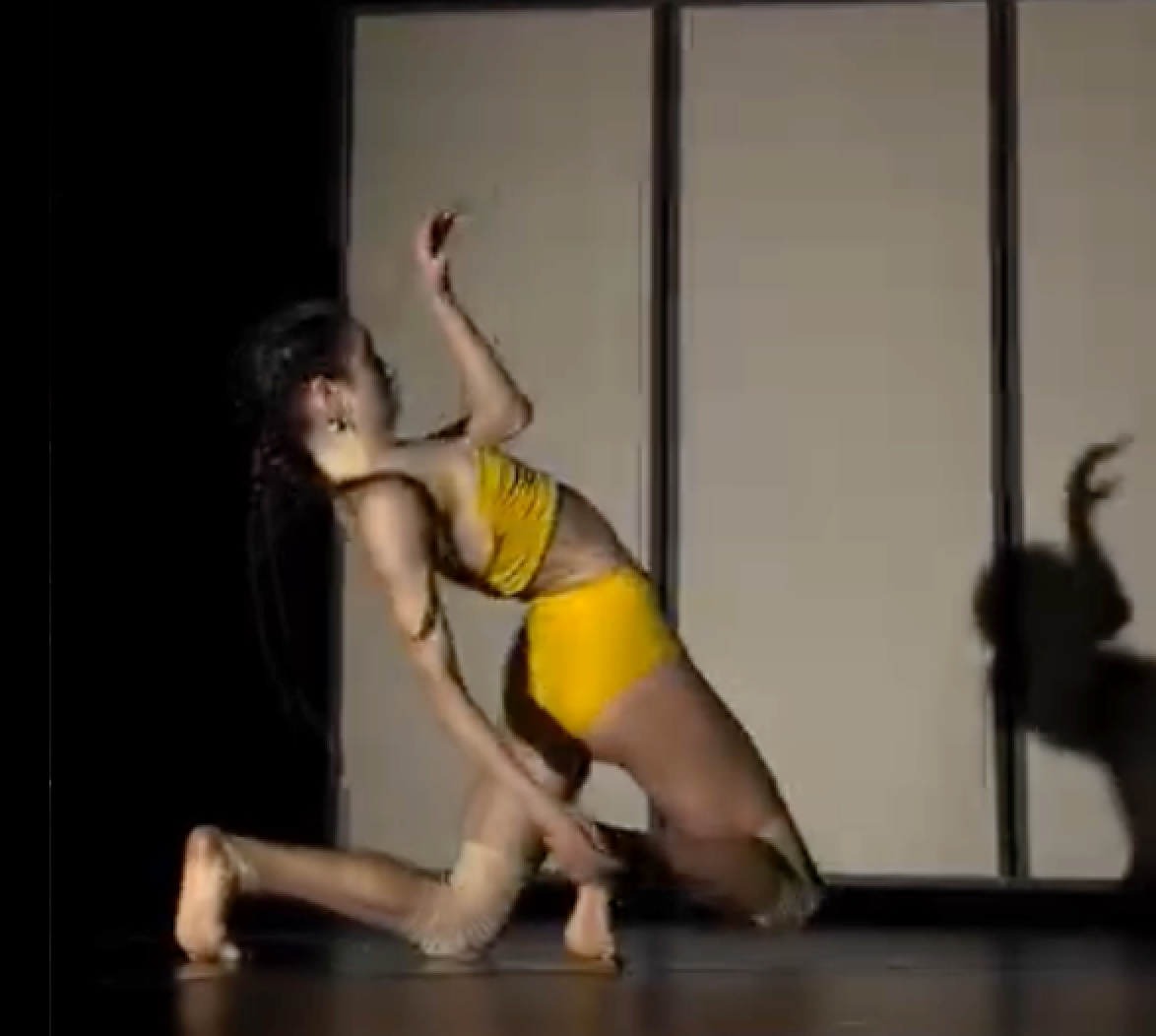 The company made a masterful showcase of Ishida’s vocabulary. All performers were standouts, but one especially to mention is Alice del Frate, who danced the Sphinx, a kind of divine monster. Light faded up on her, seemingly body-painted orange and wearing a matching halter and thong bikini bottom. Her extreme movements proceeded from a crouch, giving the work the impression of a menacing spider. The final monstrous touch was a raccoonlike band of makeup across her eyes. Menacing is hardly the word: fear-casting might be a better construction. Her flying, spindly arms and legs while Rex carried her off vanquished reminded one of the squirming snakes of Medusa’s head. But that’s a myth for another day.
The large cast made a collegial group: Remy Feldbruegge as Rex, Helen Clare Kinney as Jocasta, Thomas Martino as the Messenger, Alice del Frate as mentioned, and the chorus of Mimi Lamar, Emily Wilson, Emma Marcellana, Patricio Hoyo, Chance Phelps, Alexandr Veselý, Tiemen Stemerding, and Abigail Baden.
In a brief chat after the show, Brett Ishida said waiting/REX was the first show of all her own choreography. To the audience, the show was a generous outpouring of intense beauty from a gifted mind. Like spoiled children, we want more (no pressure, no pressure).
waiting/REX
by Ishida Dance
Ishida Dance Company
June 18 - June 20, 2026
June 18, 29, 20, 2026
Dell Theatre, St. Andrew's Episcopal School, Austin