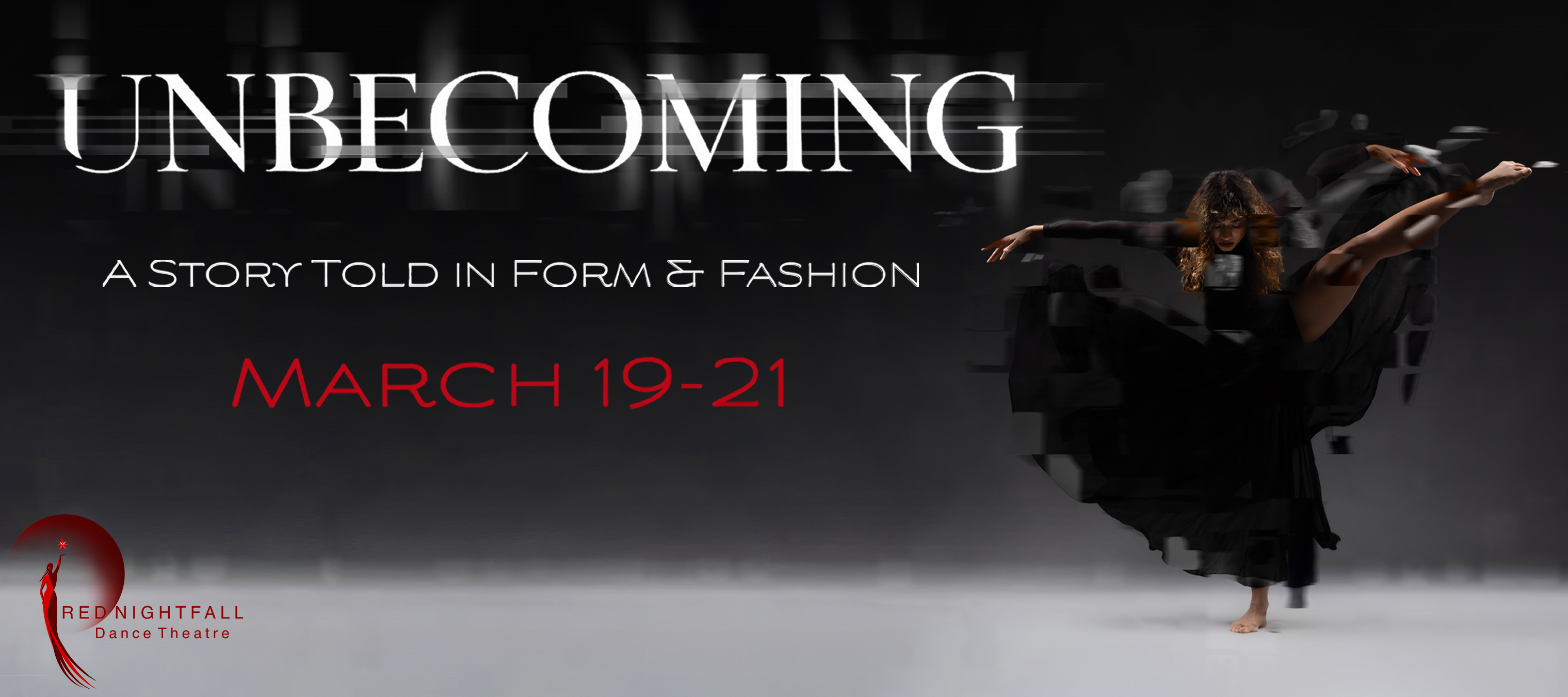
Review: Unbecoming - A Story Told in Form & Fashion by Red Nightfall Dance Theatre
by David Glen Robinson
 A nearly naked man lies in fetal position at center stage. A glaring, unfiltered white light fades up on him. Unclothed and without any ornamentation or nearby landscape of human objects, he could be anywhere or in anytime, but a primordial desert is the most obvious choice. In literature and theatre, a solo man with nothing at all symbolizes Everyman, but the audience recoils from looking at this man through that lens, fearful of what he may show us about ourselves.
He begins to lengthen, flexing and flexible, seeming to draw power from the air itself and the ground beneath him. Two performers enter from a corner entrance, unfurling a wide red fabric. Two others enter from another corner, unfurling a black fabric. They all walk to opposite corners, their trailing material forming an X across the entire stage. The crossing of the fabrics lies over the still-recumbent Everyman. He rises to a powerful dance, wrapping himself and the stage in red and black. “The Dark Birth,” the dance’s title, also shows us the highly symbolic importance of fabrics, color, and fashion in the mythically based Unbecoming.
Red Nightfall Dance Theatre's Unbecoming is a contemporary ballet and much, much more. It's a modern myth full of symbols and abstract storytelling stacked with more levels of meaning and art than many contemporary ballet shows ever achieve. The work and its core story comprise the third installment of Red Nightfall’s The Crone series. The concept embraces the Divine Feminine and goes beyond it to tell a story of transformation, conflict, deception, treachery, and pain. It teaches us that we must discover our higher values and cling to them. The story also comes with a warning: the darkness has fangs. The concept and story are by artistic director Dorothy O’Shea Overbey. She was her own main scribe, with story consultants Elaine Fields and Madeleine O’Shea Robb.
The choreography turns, and sometimes spins, around major mythic characters. Each of three characters, The Prodigy, The Zealot, and The Follower is danced by a professional dancer, and they are modeled sometimes by two performers heavily costumed in high fashions of advanced concept. The fashions symbolize and present signs of the characters’ archetypal selves. Think Tarot cards for another planet. The dancers sally to action among and against the other characters. Such multi-bodied characters of many refractions are explained in the program notes: “The models carry each figure’s transformation visibly: entering as one self, returning as another. The dancer lives the journey between.” Other characters without models are The General, the Mother, and The Follower’s Lover.
High fashion display is one of those purposeful levels rare in modern ballet presentations, and it's central to the mythic storyline. In the website program Overbey claims inspiration from the designs and presentations of the late Alexander McQueen. And imagery and design layer on the emotional heart of the story. The much-deserved credit for costume and fashion design in this show goes to Robby Durand of EmmaSis Designs. The models of the main characters wear and display Durand’s expressions of the full concept. Associated dancers wear inflections of those costumes and their concepts. This gives shape and color themes—team colors—to the main characters. The color themes in turn assist the telling of a complex performance story not always easy to follow.
The show is divided into six sections. Each of the first four focuses on a main character's struggles. The sections are “The Dark Birth,” “The Prodigy,” “The Zealot,” and “The Follower.” The General, whose birth we witnessed, has the powers of the warlock, or enchanter. In the second through fourth sections, he appears to enchant members of the teams and enslaves them into doing his bidding unquestioningly. We never see the culmination of his rise to power for it is thwarted, but we know he will return. The athletic and highly skilled Ty Lyons Graynor embodies the General superbly, and he makes it look easy, given his skill and Limon training. To some, the dance in these sections held a sub-theme of drug addiction. In this frame, the General symbolized a dealer in addictive substances, perhaps a cartel member, who sought to subvert others’ lives by addicting them, controlling them, and thereby increasing his own power. Regardless of sub-theme, power was central to the General.
%2C_aurora_banks_(the_prodigy)(photos_by_ashkinimage)_adj.jpg)
_adj2.jpg)
Section IV, The Follower, gave the romantic passage between the Follower (Rachel Culver) and the Follower’s Lover (Clay Moore). The end of the section contained the spectacular confrontation by two groups of dancers distinctly demarcated by costume. The group in flowing beige robes suffered confrontation from another group in tight black garments with sharp outlines. This reviewer gave it the moniker “The Coming of the Spiders” to convey part of the well-enriched dance. The entire show was enriched, almost to an overwhelming degree.
As if Dorothy O’Shea Overbey’s collective choreography weren’t enough, Unbecoming gave yet another surprise. The fifth section, “Interstice,” was guest choreography by Alexa Capareda. The piece was performed by the company dancers to piped-in classical music. The dance featured Capareda’s signature floorwork across a lighting floor pattern of geometric black and white shapes, a projection design by Scott Gregory.
The final section, “The Mother Rises,” was just that. The figure of the Mother was masked and seemingly hidden behind masses of fabric. With the assistance of the entire ensemble, and in slow movements, the fabrics grew, blossomed, and bloomed into a huge interactive flower seemingly occupying half the stage. The Mother, played by Cellise Brown, emerged from the center, crowned by a towering, monumental headdress, pistils and stamens arcing upward and outward. Her tableau was a beautiful springtime offering of hope to end the show.
_adj.jpg)
The ensemble of dancers performed multidimensional work of significant complexity. All except Graynor danced multiple characters. They are, in no particular order, Megan Davidson, Kanami Nakabayashi, Rachel Culver, Clay Moore, Ty Lyons Graynor, Cellise Brown, Elaine Fields, and Jessica Siclari. The Models were Aurora Banks, Georgia Garner, Neha Mambapoor, Jonathan Oliver Foster, Laney Phillips, and Juniper Darrow.
The lighting design was by Trent Brown and Katy Hallee of Doghouse Productions. Trent Brown accompanied on the piano and Sofia Gonzalez played cello. Altogether, Unbecoming was a multimodal treasure, and its audiences look forward to the next installment of The Crone.
Unbecoming - A Story Told in Form & Fashion
by various
Red Nightfall Dance Theatre
March 19 - March 21, 2026
Performance Dates:
* Thursday, March 19 @ 7:30pm
* Friday, March 20 @ 7:30pm*
* Saturday, March 21 @ 6:30pm & 8:30pm

Location: East Side Performing Arts, 979 Springdale Rd, Austin, TX

Accessibility: *ASL interpretation will be provided at the Friday, March 20 performance.