At Austin’s Mexican American Cultural Center, a fight over identity and the future of Latino arts, by Emiliano Tahui Gómez, Austin Statesman, 12/01/25
City management has given the MACC stability but also a certain static, artists say. When the expanded center reopens next year, will things change?
Shared by Paul Saldaña, HABLA (Hispanic Advocates Business Leaders of Austin)
Click to view at Austin Statesman, with photos
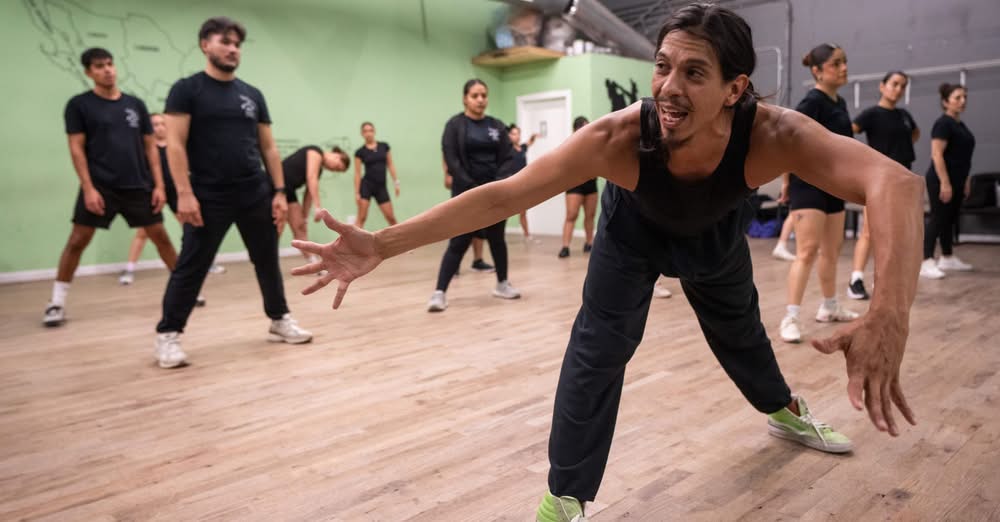
For performing artist Luis Ordaz Gutiérrez, the faltering aspirations of the Emma S. Barrientos Mexican American Cultural Center have been noticeable in its recent programming: chair yoga, holistic wellness and rowing classes.
He sees those non-artistic offerings as evidence of a widening disconnect between the center’s current operations and its mission to work toward “the preservation, creation, presentation, and promotion of the cultural arts of Mexican Americans and Latino cultures,” as stated on its website. Seven artists, founders and former board members who spoke to the Statesman shared this concern, which they said have been exacerbated by the center’s long closure. That view contrasts with that of center manager Michelle Rojas, who said her team has tried to offer Latinos a broader range of programming they might not otherwise access.
The contentions reflect the age-old question of what government’s role in the arts should be.
“You have city staff and you have government dictating culture and artistic programs,” said Ordaz Gutiérrez, who was born in Mexico, raised in Austin and is currently the director of the dance group ProyectoTEATRO. “They have been given the power to determine what culture and art looks like.”
The center is scheduled to reopen in spring after a three-year expansion, and artists and community members long-involved in its development hope the return will restore its focus on fine arts and the artist behind them. Built in 2007 after two decades of activism by Mexican American artists and community members, the center remains a place where the questions over the ideals, aspirations and realities of Latino arts continue to play out.
Like many artists hungry for a space to create, Ordaz Gutiérrez is hopeful but unsure about the center’s future. To him and others, Austin holds an unrealized ideal. If and how the center evolves after it reopens may well define the city’s future relationship with Latino artists.
Tomas Salas remembers the push for a cultural center he joined in 1994. Mexican Americans, he said, wanted to recoup what had been lost with [the 1983 demolition of Juárez-Lincoln University](https://www.statesman.com/.../preserving-the.../9791024007/), a Chicano-era institution of higher learning founded in Austin in 1971. But the effort was, in a word, sleepy.
It would take the rest of the decade — the creation of a nonprofit, numerous board meetings, two attempts at a bond measure, shifting leadership and a successful series of programs at an uninsulated metal warehouse on a city maintenance yard just off Rainey Street — to boost momentum, said Salas, a performing artist who ran the center during those early years when it was independent of the city.
The opening of the center in 2007 marked a victory for a generation of Mexican Americans, proof of both the efficacy of sustained activism and their growing power at City Hall. With exhibition halls, a dance studio and a theater, the center promised space for production and performance that Mexican American and Hispanic artists had long struggled to access. Its first catalogue boasted classes in painting, writing, cinematography, sewing and Spanish.
Although not yet fully felt, the center’s stability was already being tested. Throughout its early and later years, advocates fought off attempts by developers to persuade the city to sell the coveted riverfront tract of the maintenance yard, said University of Texas professor and former center board member Emilio Zamorra. Eventually, Mayor Gus Garcia, the city’s first Mexican American mayor, signed a resolution preserving the land for the center in perpetuity.
At the same time, infighting weakened the nonprofit, Salas and others involved in the project said. City management represented stability — and continuity. The city assumed complete control in the early 2000s, shortly before construction of the building began, according to Roen Salinas, a dance troupe leader who helped champion the project.
The final product — a striking modernist structure, austere and white like teeth — rose on the former warehouse site along Lady Bird Lake. It became a point of pride. [Teodoro González de León](https://www.nytimes.com/.../teodoro-gonzalez-deleon-dead...), the famed Mexican architect, worked the community’s aspirations into the facility’s design, envisioning a crescent-shaped complex to be built in phases, with three pyramidic theaters rising from its arc. (The crescent moon shape will be completed by the current expansion, and there is currently one theater built.)
It was a victory for an arts community that had often felt, as Salas put it, “like a stepchild” competing with white artists for space at Austin's legacy art facilities and, as longtime Mexic-Arte executive director Sylvia Orozco recalls, overshadowed by San Antonio’s national reputation as a hub of Mexican American arts.
“It’s one of the major accomplishments in the recent history of the Mexican American community,” Zamora said. “It is a culmination.”
The past six years have proven particularly difficult for the center. The city closed the building in 2020 amid the coronavirus pandemic, forcing remote operations for more than a year. It reopened with strict capacity limits because of social distancing rules, only to close again after a year for the current expansion project. After construction delays derailed a planned reopening in November, the building is now set to reopen in March, city project manager Heidi Tse told the center’s advisory board in November.
The remote operations have limited the center’s ability to offer the variety of courses and services it traditionally has. But even before then, programming choices and limited support for artists have left the center feeling more like a recreation center than an arts hub, said former center employee and performing artist Ryan Salinas, 34. For two decades, it was managed by the city department whose bread and butter is just that: Parks and Recreation. But this year, the center and [Austin’s other cultural facilities](https://www.statesman.com/.../austin-s-black-cultural...) were moved under the city’s new Office of Arts, Culture, Music and Entertainment.
As Ordaz Gutiérrez and Salinas see it, the city has sought to use the center to please as many people as possible rather than to meet artists’ needs. Artists want help with grant writing, teaching opportunities and connections to rehearsal and performance spaces.
Rojas, the center’s manager, said the programs most criticized by some, like the chair yoga and the rowing, were intended to increase access to activities Latinos have not traditionally had, a perspective shared by board members.
But many artists feel differently. As one former center staffer, visual artist Paul del Bosque told the Statesman: Though artists understand the limitations currently placed on staff, “the mission of the MACC is much, much deeper — much, much more personal" than what’s being offered.
Rojas said that the center’s programs will expand when the facility reopens, allowing it to offer as diverse a set of programs as ever, such as new cooking class through a newly-constructed kitchen.
But returning to what was the past status quo, won’t be enough, said, Roen Salinas, Ryan’s father. More than that, the facility will have to work to mend the growing divide between artists and decision-makers.
“As opposed to being contractors, the MACC needs to create another input apparatus so that the artists can contribute,” Roen Salinas said.
Despite their frustrations, Ordaz Gutiérrez and the Salinas said they want to return to the center and help shape its future. During the building’s closure, artists have scattered — to makeshift studios, to venues across the city or out of Austin entirely. With the center’s closure and other city arts funding roll backs, some artists stepped away more completely from their craft, shifting full-time to jobs like AC maintenance, Ordaz Gutiíerrez said. The reopening offers a chance to rebuild a fractured community.
“If you go through the rosters of major American cities, not a lot have Mexican American cultural centers. We are privileged to have that space,” Ordaz Gutiérrez said.
It will also open the door for all sides to work on what they agree is essential: reengaging an [increasingly dispersed Latino population](https://www.statesman.com/.../austin-black.../71958820007/) to keep them connected to a center created for them but now at risk of losing relevance as a downtown institution pressed by the high-rises transforming the Rainey Street neighborhood.
Reaching the community, Roen Salinas said, is both an artistic responsibility and a path to making stronger work.
During the closure, the center has run programs at satellite locations such as libraries and recreation centers in Dove Springs, Montopolis and Northeast Austin. The center plans to maintain some neighborhood presence, though it will shrink as resources shift back to the main building and as funding tightens, Rojas said.
Even with those challenges, expanding there is a desire by all to help the center do this, potential for a collaborative effort that could restore the sense of aspiration that animated the center’s creation, Roen Salinas said.
Getting a community to dream together, he said, “that's the power of the arts.”